


Disneyland With a Disability: What My Birthday Taught Me About Traveling Differently

I went back to Disneyland for my birthday knowing the park would ask more of me than it once did. What I didn’t expect was how much the day would remind me why I still travel in the first place.

Alt text: Ed and Jason Danielak smile together outside Disneyland during the park’s 70th anniversary celebration on Ed’s birthday trip.
There are probably better ways to plan a Disneyland birthday than deciding to go the day before.
Jason and I did it anyway.
On August 3, 2026, we pointed our Tesla Model 3 west from Phoenix toward Anaheim with a motel reservation, one day at Disneyland and considerably less planning than either of us would probably recommend in hindsight.
I was excited. Really excited.
Disneyland has always been one of those places that can do that to me, and I had not been back to the California park in a few years. I had traveled since my brain injury in 2019, including trips to Walt Disney World in Florida and Disney in Japan, so this wasn't some triumphant first venture into the world again.
I knew I could travel.
I also knew what traveling asks of me now.
My vision isn't what it once was. Loud environments can overwhelm me. Some of my medications make heat difficult to tolerate. Physical fatigue can arrive with a heaviness that is hard to explain to someone who hasn't felt it. Cognitive fatigue has a way of turning seemingly simple things, like following directions or deciding where to eat, into work.
None of that meant I didn't want to go to Disneyland.
It meant I had to figure out how to do Disneyland as the person I am now.
Fortunately, Jason was driving.
Sometimes the Car Decides When You Rest
The drive from Phoenix to Anaheim gave me something Disneyland wouldn't necessarily give me the next day: mandatory breaks.
Our Tesla dictated the rhythm. Every so often the car needed charging, so we stopped whether we were ready to or not. I could get out, stretch, find something to eat and, because apparently caffeine was going to become one of the supporting characters in this birthday story, find more Starbucks.
I couldn't decide whether I liked those stops.
A gas-powered car could have been filled in a few minutes and gotten us to Anaheim sooner. On the other hand, the Tesla kept forcing us to stop.
That distinction would become much more interesting the following day.
On the road, stopping was built into the itinerary.
At Disneyland, I would have to give myself permission to do it.
We arrived in Anaheim on August 3 and decided to have a little Disney before our actual Disney day. We parked at the Pixar Pals Parking Structure and took the pedestrian walkway into Downtown Disney. We had dinner at Earl of Sandwich, did some shopping and eventually took the tram back to the parking structure.
Then it was time to get some sleep.
A Room That Only Needed to Do One Job
We stayed at Motel 6 Anaheim Maingate.
There was no fantasy involved in choosing it. We wanted one of the less expensive options because, in our minds, the room had one basic job: give us somewhere to sleep.
We had an accessible room with a roll-in shower. It was a no-frills stay, as expected, but there were things I noticed.
The curtains didn't block the light particularly well, and the accessible bathroom was unfortunately in less-than-ideal condition.
Those details mattered more than they might have before my brain injury.
Routine helps me manage cognitive fatigue. When something changes the way I normally get ready or recover, it creates another adjustment for my brain to make. The condition of the bathroom made my normal morning routine less inviting, and I found myself wanting to get ready quickly and leave.
Besides, Disneyland was waiting.
We only had one day.
I wanted to make it count.
My Birthday Started in a Parking Lot
August 4 was my birthday.
We drove to the Toy Story Parking Area, and before we did anything else, I made a decision about how visible I wanted my disability to be.
I have a Hidden Disabilities Sunflower lanyard, and I actively support the program. I find it particularly useful in places with a lot of logistics, airports being an obvious example.
Disneyland arrival can be another.
After parking, I put it on for security screening at the Toy Story lot and kept it on for the complimentary bus ride to the Disneyland Resort.
Once we arrived and I felt settled into the day, I took it off.
I like what the lanyard communicates. Sometimes it can save me from having to immediately explain that there may be something happening with me that another person cannot see.
But sometimes I also just want vacation pictures.
I don't necessarily want to look back at every photograph from my birthday and have a visual reminder of my disability hanging around my neck.
Jason and I later wondered whether keeping it on might have made a few interactions easier.
Maybe.
But that question gets to something important about hidden disabilities.
I shouldn't need to be wearing a particular symbol before someone recognizes that I might have an accessibility need.
Not all disabilities announce themselves.

Alt text: Ed holds his Disneyland Happy Birthday button toward the camera during his August 4 birthday visit.
The Weight Nobody Else Could See
For the first part of the day, excitement did a pretty good job competing with fatigue.
Eventually, fatigue started winning.
The best way I can describe the physical sensation is that it felt as though I were walking around Disneyland carrying an extra 10-pound weight on top of me.
Nobody else could see it.
I could feel every pound.
Then there was the mental work.
Disneyland requires a surprising number of decisions when you start counting them. Where are we going next? Which direction? What should we eat? How long is the wait? Where do I check in? How far away is the next attraction? Where can I sit?
Most people probably don't consciously tally those questions.
My brain does.
One of the places I noticed it most was wayfinding.
On previous Disney visits, I remembered Cast Members giving very clear directions, often accompanied by Disney's familiar two-finger directional gesture. On this trip, some interactions were different.
I would ask where something was and get a verbal answer that wasn't precise enough for me to understand. I would ask again. Sometimes I still wasn't sure.
Eventually, I would move along and ask another Cast Member.
That sounds like a tiny inconvenience.
But disability can make tiny inconveniences cumulative.
An unclear direction means more processing. Getting turned around means more walking. More walking means more physical fatigue. Then I have to stop, reorient myself and make another decision when my brain is already getting tired of making decisions.
Many Cast Members were patient and helpful. Some were excellent.
Others simply did not meet the level of communication I remembered from previous Disney visits.
I wasn't thinking only about myself when it happened, either. I kept wondering how many other guests might be wandering around the park having the same problem.
Sometimes accessibility is not an elevator, ramp or separate entrance.
Sometimes it is someone realizing I need another few seconds to process what they just said.
Sometimes it is a clear direction.

Alt text: Ed points toward passing entertainment while navigating a busy outdoor area of Disneyland.
“Sometimes I need somebody to point clearly and give my brain a moment to catch up.”
What DAS Could Do, and What It Couldn't
Before the trip, I had spoken by video with a Disney Cast Member about my accessibility needs and Disability Access Service, commonly called DAS.
That interaction was helpful. The Cast Member listened and gave me useful advice.
Inside Disneyland, DAS and the Cast Members assisting with accessibility helped with particular parts of the day. When I needed to know exactly where to check in, I could get help. If I needed an elevator, Cast Members could direct me there.
That mattered.
But there is a difference between helping me access an attraction and helping me manage an entire day.
DAS couldn't give me a nap.
It couldn't make the August heat disappear.
It couldn't turn Disneyland quiet.
And it couldn't always give me somewhere comfortable to sit when my brain and body needed a break.
Finding the combination of seating, shade, fewer people and less noise was difficult enough that eventually I changed the goal.
I stopped looking for quiet.
I looked for air conditioning.
This is Disneyland, after all. At some point, I had to accept that loud was part of the deal.
Cooling down inside gave me enough of a reset to continue. So did finding places where I could refill my water bottle rather than continually paying for bottled water.
Those ordinary things mattered as much to my day as some of the formal accommodations did.
One accommodation cannot solve every accessibility problem.
Something can make an attraction more manageable without solving fatigue. It can help me access an experience without giving me somewhere to recover afterward.
Accessibility is everything that happens in between, too.

Alt text: Ed smiles from an Astro Orbitor ride vehicle at Disneyland while Jason takes a playful foreground selfie.
The Great Starbucks and Sugar Strategy
Our decision to book the trip the day before came back to haunt us around mealtime.
We mostly relied on quick-service restaurants and Mobile Order. That was convenient, but I didn't have a carefully planned sit-down meal waiting for me when my energy began dropping.
My solution was extremely sophisticated.
I got another Starbucks.
Then I ate more food that was high in sugar.
Energy!
And then, inevitably:
Not energy.
The quick boost kept me moving, but the crashes became more frequent. What I really could have used was more substantial food and a longer period sitting somewhere cool.
The problem was psychological as much as logistical.
We had one Disneyland day.
Every break felt like time I wasn't doing Disneyland.
Going back to the motel for a nap would have been even more complicated. We would have needed to leave the resort, take the bus back to Toy Story, get into the car, drive to the motel, rest and then reverse the entire process.
We have stayed at Disney resorts before, where coming and going was much easier.
This time, once we were inside Disneyland, I felt committed to staying.
So I kept asking myself the same question:
How much farther can I push?
Disneyland Had a Birthday Present for Me
Fortunately, fatigue wasn't the only thing accumulating.
There were also the moments that reminded me why I had wanted to come so badly in the first place.
Disneyland was celebrating its 70th anniversary, which meant Disneyland and I were both celebrating birthdays.
At Red Rose Taverne, we got the wonderfully named 70th Stuff, a colorful combination of shortbread cookie, Cookies and Cream cake, raspberry and raspberry jam, surrounded by white chocolate mousse and topped with sprinkles.
And sitting right on top was a little candle.
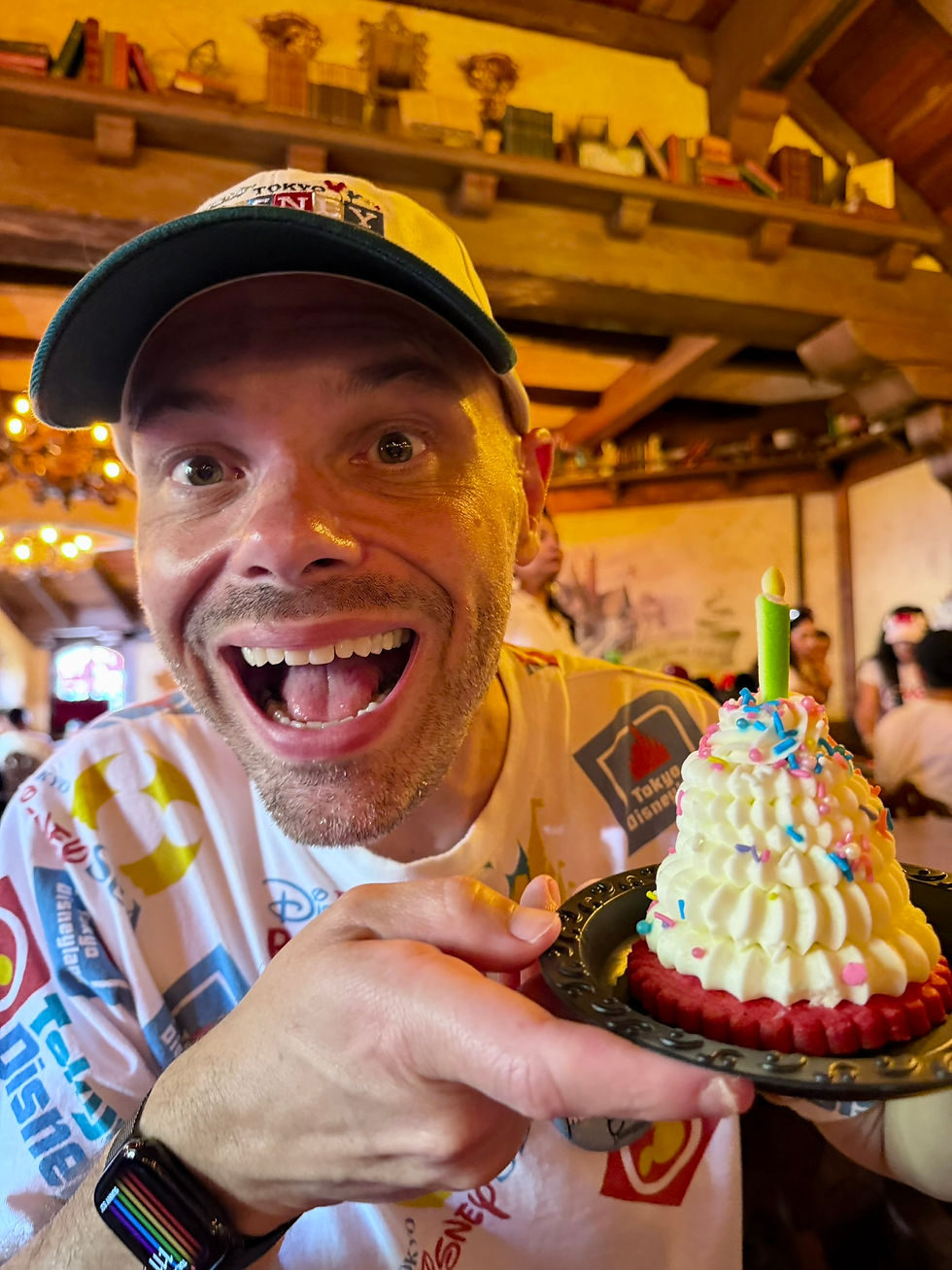
Alt text: Ed grins while holding Disneyland's 70th Stuff dessert at Red Rose Taverne during his birthday celebration.
Jason hadn't secretly arranged the candle.
It comes that way.
Disneyland had apparently prepared its own birthday dessert and accidentally made it perfect for mine.
After spending so much of the day thinking about fatigue and logistics, there was something delightfully uncomplicated about that.
Cake.
Candle.
Birthday.
Perfect.
And Then Galaxy's Edge Changed the Night
As daylight disappeared, the park changed with it.
We made our way to Galaxy's Edge, where we saw Shadows of Memory: A Skywalker Saga and Fire of the Rising Moons.
I already loved Galaxy's Edge.
But this wasn't simply another visit to a favorite part of Disney.

Alt text: Ed watches the rocky landscape of Star Wars: Galaxy's Edge illuminated in vivid red and blue during a nighttime show at Disneyland.
I had visited Galaxy's Edge in Florida when it opened, shortly before I had to go through cancer treatment.
Standing in Galaxy's Edge again years later, on my birthday, that memory came rushing back.
A lot had happened between those two visits.
Cancer treatment.
My brain injury.
A disability that changed the way I experience places like this.
A body and brain that now sometimes require negotiations just to get through a day I desperately want to enjoy.
And there I was.
The lights were moving across Galaxy's Edge. Jason was beside me. I was celebrating another birthday.
For once, I wasn't thinking about where I needed to sit next.
I wasn't thinking about whether I was too hot.
I wasn't thinking about how many steps were left or whether I could find the next place I needed to go.
I was thinking about the fact that I was still there to see it.
“Joyful to know that I've survived.”

Alt text: Ed and Jason stand together looking toward the illuminated landscape of Star Wars: Galaxy's Edge during Ed's birthday visit.
When I realized how special the connection was between those two visits, I simply felt appreciative to still be there.
That was the full-circle moment.
It is also probably the best explanation I can give for why, after everything I've just described, I still love going to Disneyland.
Traveling Differently Is Still Traveling
If I could redo the trip, I wouldn't try to prove that I could push harder.
I'd plan better.
I would book farther in advance and make dining reservations so that a substantial meal and some time in air conditioning became part of the day instead of feeling like an interruption to it.
I'd plan a route through Disneyland rather than bouncing from one location to another. Getting turned around isn't just annoying when cognitive and physical energy are limited. It spends energy I could have used enjoying something.
I'd also give more weight to where we stay.
Our motel served the purpose we chose it for and helped keep a spontaneous trip affordable. But this visit reminded me that proximity can itself be an accessibility feature.
A nap isn't particularly useful when getting to the bed and back becomes an expedition.
Most importantly, I would remind myself that resting isn't wasting Disneyland.
That may be the lesson I still need to learn.
I also want other disabled travelers to know that self-advocacy matters.
Tell people what you need.
Explain what is difficult.
Give Disney the information it needs to determine which accessibility services may be appropriate for you.
A diagnosis doesn't tell another person exactly what you need, and another person's disability may look nothing like mine.
Sometimes I need a physical break.
Sometimes I need a mental break.
Sometimes I need water and air conditioning.
Sometimes I need somebody to point clearly and give my brain a moment to catch up.
And sometimes I want to take off the Sunflower lanyard, put my arm around my husband and take a birthday picture without disability being the first thing I see.
All of those things can be true at once.
That's what traveling with a disability looks like for me.
It isn't a story about going to Disneyland despite my disability.
My disability came to Disneyland with me.
So did Jason.
So did the fatigue and the Starbucks, the birthday button, the 70th Stuff and all those decisions about whether I could squeeze in one more thing.
And so did the joy.
Would I go back?
Absolutely.
I'll go whenever I can.
It's the Happiest Place on Earth, after all.
And standing beside my husband in Galaxy's Edge on my birthday, grateful simply to still be there, I couldn't think of anywhere else I would rather have been.

Caption: Apparently neither of us was particularly excited about leaving.
Alt text: Ed and Jason make exaggerated sad faces beneath the illuminated Disneyland
Resort sign at the end of Ed's birthday visit.
What Helped Us
Talking with Disney before the trip. I explained my individual accessibility needs rather than assuming a diagnosis automatically meant a particular accommodation.
Using the Hidden Disabilities Sunflower when I wanted it. I wore my lanyard during the more logistics-heavy arrival process and chose to remove it later.
Air-conditioned breaks. When genuine quiet wasn't realistic, getting out of the heat helped me reset.
Water refills. Being able to refill my bottle throughout the park made managing the heat easier.
Mobile Order. It simplified quick-service meals during a very packed day.
Having Jason drive. Not driving between Phoenix and Anaheim let me conserve energy.
Asking again when I needed to. If directions weren't clear, I asked another Cast Member rather than pretending I understood.
These are things that helped me on one specific trip. Disabled travelers have different needs, and my experience isn't a universal accessibility guide.
What We Would Do Differently
Next time, we would plan earlier, build at least one substantial sit-down meal into the day, create a more logical route through the park and treat planned recovery as part of the itinerary rather than time lost from it.
We would also give more consideration to accommodations that make returning to the room for a midday rest practical.
The goal wouldn't be to squeeze less value out of Disneyland.
It would be to leave enough energy to appreciate the moments we came for.
About Disneyland Disability Access Service
Updated August 9, 2026
This story describes my personal experience at Disneyland on August 4, 2026.
As of publication, Disneyland describes Disability Access Service, or DAS, as a program intended for guests who, because of a developmental disability such as autism or similar, are unable to wait in a conventional queue for an extended period. Disney determines eligibility through an individual conversation with a Cast Member, currently available through live video chat or at an Accessibility Services Kiosk.
DAS does not provide immediate attraction access. Eligible guests can instead request a return time comparable to the current standby wait. Disneyland currently allows registered guests to request those return times through the Disneyland app, Guest Relations or Accessibility Services. Disney also offers other accessibility services, so DAS should not be understood as the only option available to disabled guests.
Procedures and eligibility can change. Before visiting, check Disneyland's current information and discuss your individual needs directly with Disney.
My experience is exactly that: my experience, on one particular birthday at Disneyland.
And it was quite a birthday.


Comments